
LCD stands for Liquid Crystal Display, which is what we commonly call a liquid crystal screen. Liquid crystal (LCD) is currently the most mature display technology. Due to factors such as cost, yield rate, and market acceptance, it is the most widely used screen display technology on the market. In mobile phone screens, LCDs are mostly used in mid-range and lower-end flagship phone models, while high-end flagships have recently switched to using OLED screens.
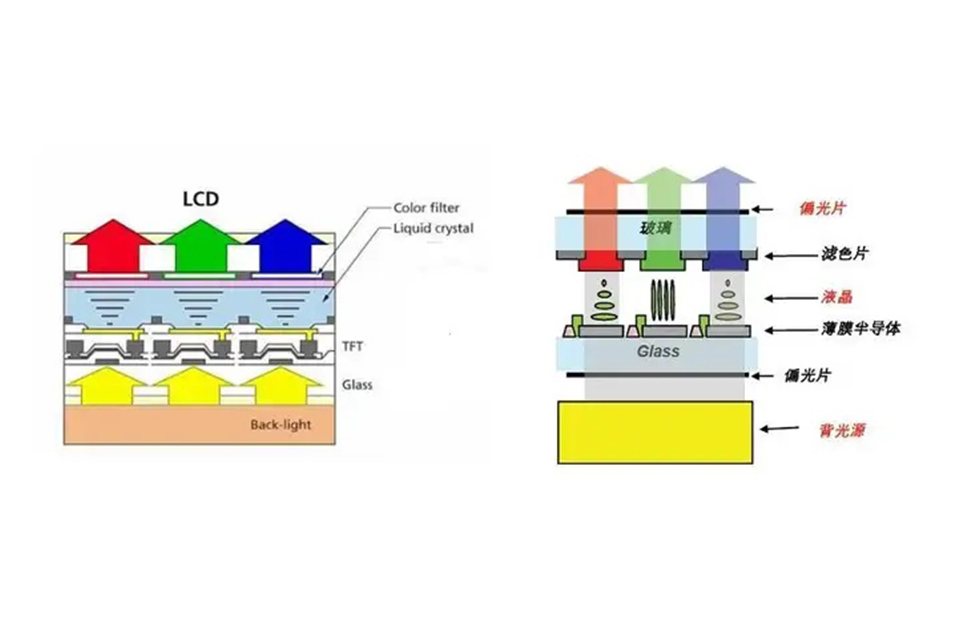
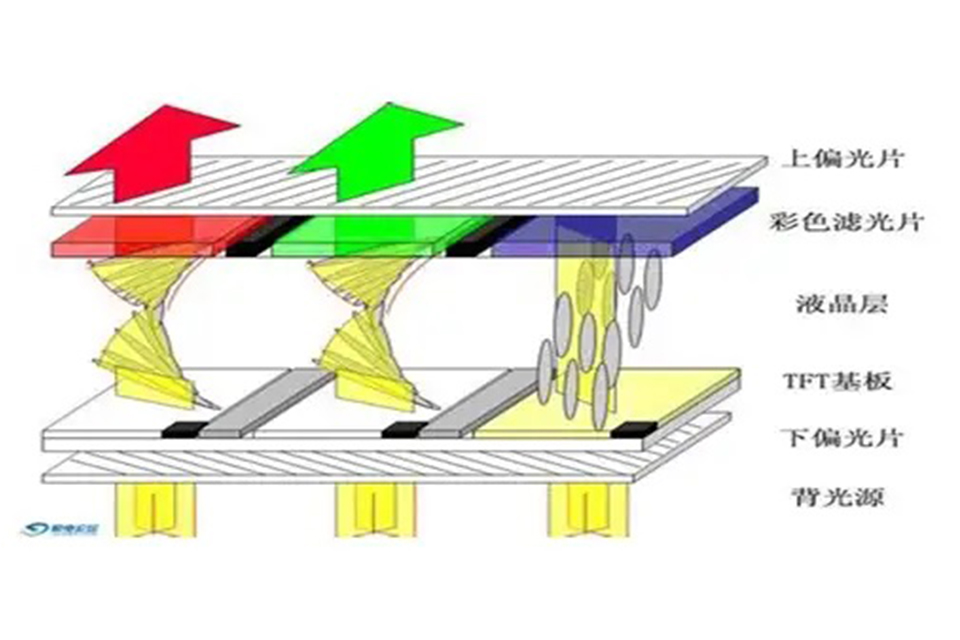
Simply put, its panel mainly has three layers: a backlight layer, a liquid crystal layer, and a color filter layer.
The principle of LCD light emission is mainly based on the white light emitted by the light bulbs or LED bulbs covering the backlight layer, which then passes through the red, green, and blue color film layers to display various colors. However, if it were only like this, the proportion of colors could not be controlled. Therefore, a liquid crystal layer is added between the backlight layer and the color layer. The main function of the liquid crystal layer is to use an electric field to control the rotation of the liquid crystal molecules, thereby changing the direction of light travel. In this way, different electric field strengths will produce different proportions and colors of images. This is the technical principle of liquid crystal (LCD), which is a passive light-emitting technology.
The Chinese name for OLED is "Organic Light-Emitting Diode," also known as "Organic Electroluminescent Display" or "Organic Light-Emitting Display Technology." Simply put, it refers to the phenomenon of organic semiconductor materials emitting light under the drive of an electric field.
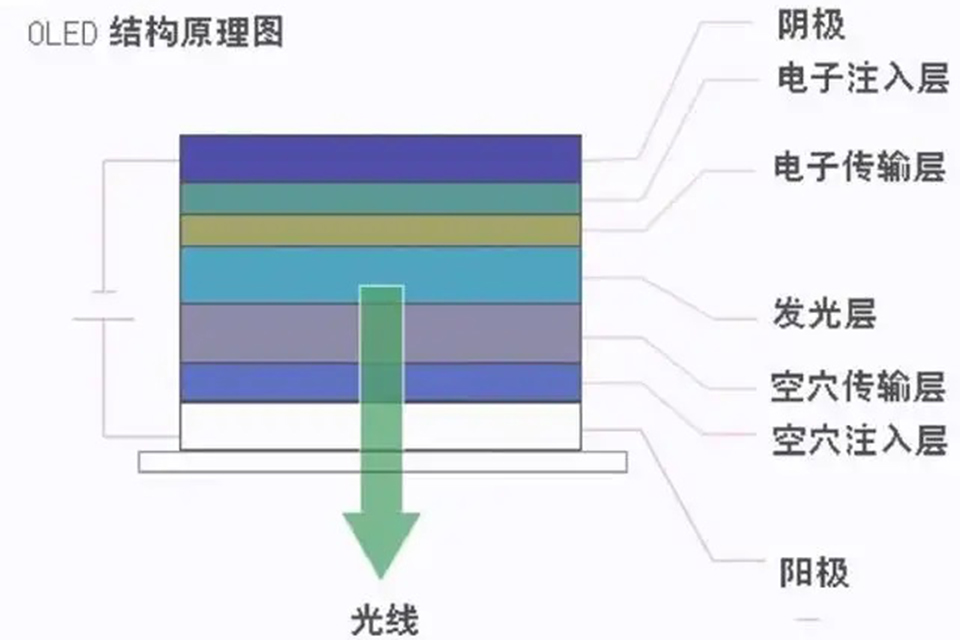
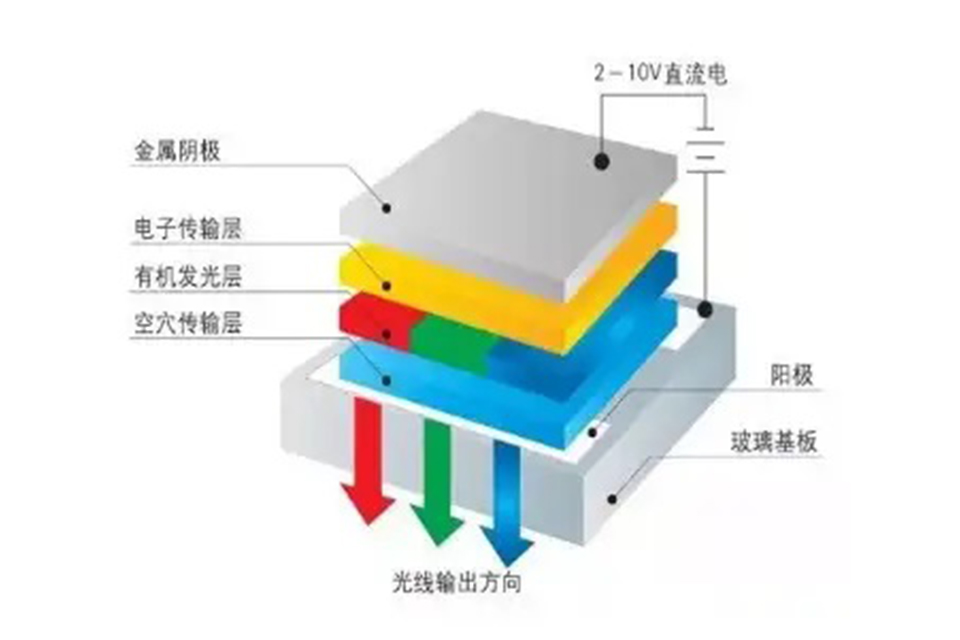
The main structure of an OLED consists of an organic light-emitting layer and a glass substrate.
The principle of OLED light emission: A layer of organic light-emitting material tens of nanometers thick is fabricated on a glass substrate as the light-emitting layer. Light is emitted under the action of electrons injected by the electrodes. Specifically, electrons and holes injected by the electrodes combine in the light-emitting layer to form electron-hole pairs, or excitons, in a bound energy level. The excitons then radiate and de-excite, emitting photons and producing visible light. The structure, function, and luminescence principle of OLEDs are quite complex and may be difficult for non-professionals to understand. It's sufficient to know that OLEDs are completely different from liquid crystal (LCD) displays. They don't require a backlight, using a very thin layer of organic material and a glass substrate. When current passes through, these organic materials emit light. This is the technical principle of OLEDs; OLEDs are self-emissive. They are much thinner than LCDs, giving them significant advantages in terms of folding, bending, and energy consumption. However, large-scale production of large screens is not currently feasible, so they are mostly used in portable products such as mobile phones.
IPS stands for "In-Plane Switching" technology. IPS is an enhanced technology of liquid crystal technology, belonging to the larger category of liquid crystal displays (LCDs).
Its principle is: to improve the viewing angle by switching the liquid crystal molecules in a planar manner, utilizing spatial thickness, friction strength, and effectively using the change driven by the lateral electric field to allow the liquid crystal molecules to rotate at the maximum planar angle to increase the viewing angle; IPS changes the arrangement of liquid crystal molecules and the distribution of electrodes, and the working conditions are also changed. When no voltage is applied, the liquid crystals do not rotate at all, and the two orientation layers are perpendicular to each other, displaying a relatively pure black. After applying voltage, the liquid crystal molecules rotate to a vertical position, allowing light to pass through. This results in a wider viewing angle, higher contrast, higher resolution, and brighter color display.
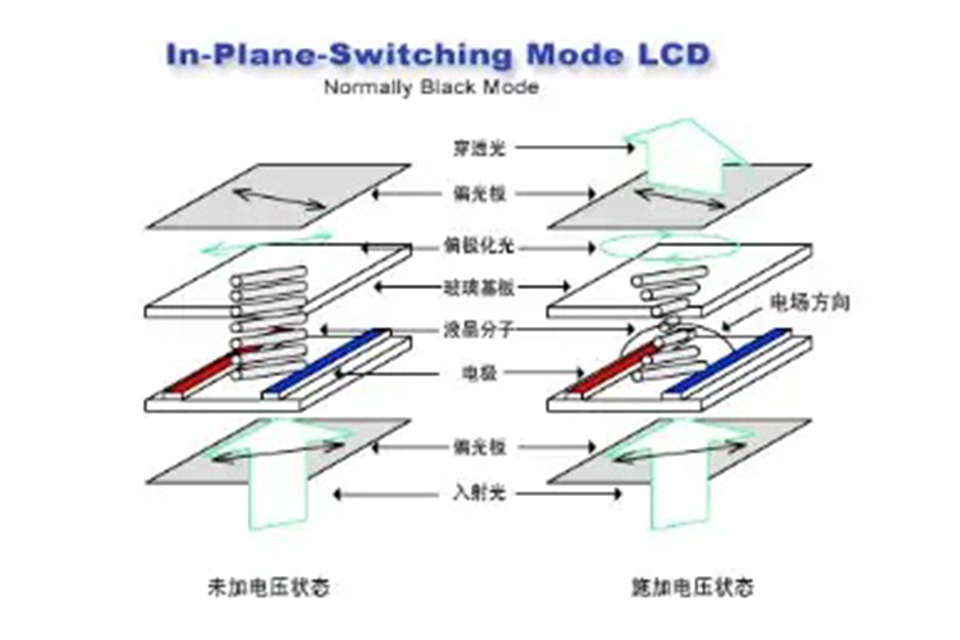
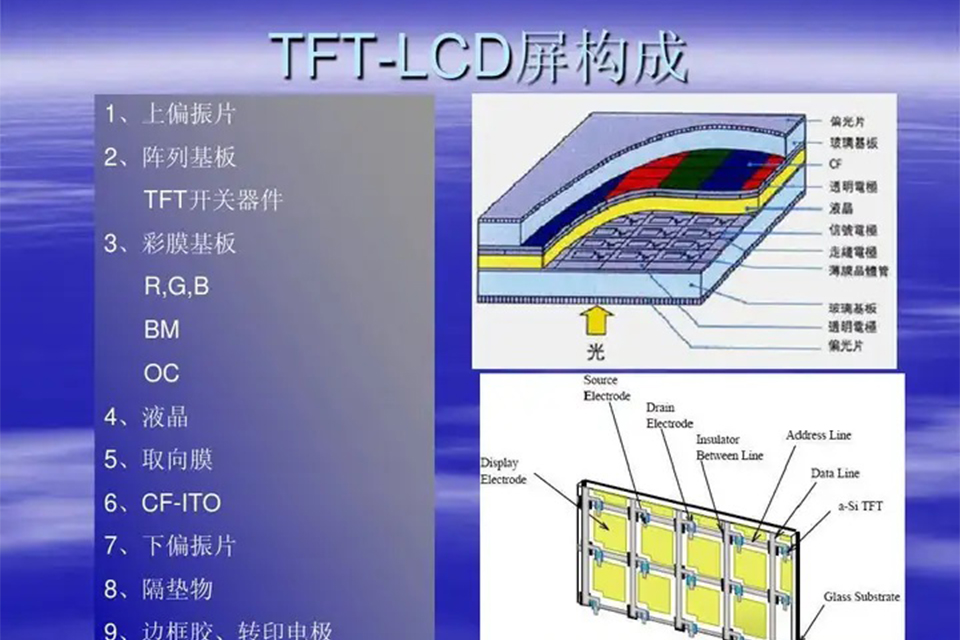
TFT refers to the fact that each liquid crystal pixel point on the liquid crystal display is driven by a thin-film transistor integrated behind it. This allows for high-speed, high-brightness, and high-contrast display of screen information. TFT-LCD (Thin-Film Transistor Liquid Crystal Display) is a type of liquid crystal display.
The main function of a thin-film transistor liquid crystal display is to use thin-film transistors to generate voltage to control the orientation of the liquid crystals. The main feature of TFT-LCD is that each pixel is equipped with a semiconductor switching device. Because each pixel can be directly controlled by a point pulse, each node is relatively independent and can be continuously controlled. This design method not only improves the response speed of the display screen but also allows for precise control of the display grayscale. TFTs have the characteristics of large area, high integration, powerful functions, low cost, flexible process, and wide application fields.
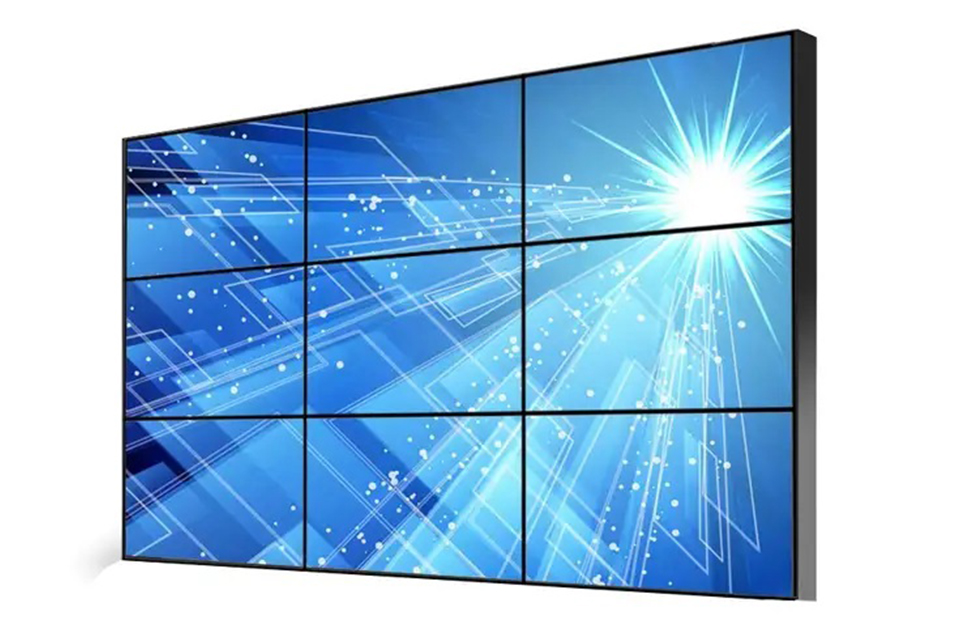
SLCD stands for "Splice-dedicated LCD screen." SLCD is a high-end derivative of LCD, using the world's most advanced industrial-grade LCD panels with a lifespan of up to 60,000 hours. SLCD is a complete splicing display unit that can be used as a single monitor or combined to form an ultra-large screen. Features include: single-screen split display, single-screen independent display, arbitrary combination display, full-screen splicing, vertical screen display, and optional image border compensation or masking.
AMOLED stands for "Active-Matrix Organic Light-Emitting Diode panel," an enhanced technology of OLED, belonging to the larger OLED category. The name AMOLED can be broken down into AM and OLED, where OLED describes the specific type of thin-film display technology, 'organic light-emitting diode,' and AM refers to the pixel addressing technology behind it. AM adds "active control." While OLEDs emit light when the correct voltage is applied to the positive and negative electrodes, without "AM" or active control, the screen would always be lit. AMOLED screens, however, require not only a signal but also additional power to bring the diodes to an operational state, at which point a signal is given to turn them on or off, resulting in the corresponding display. Samsung has also introduced Super AMOLED, which can be considered an upgraded version of AMOLED. Currently, Samsung is the only manufacturer supplying this screen, and it is considered one of the best screens for smartphone applications.
ULED is an optimization technology belonging to the LCD category, so its basic light-emitting principle is the same as LCD.
This technology was introduced by Hisense and is primarily developed for electronic medical applications and high-end LCD TVs. ULED requires a backlight to emit light; the liquid crystal molecules themselves do not emit light. LED refers to the backlight, which needs to be distinguished from OLED. ULED display technology uses multi-zone independent backlight control and Hiview image engine technology. Hisense claims that ULED significantly improves image color gamut, contrast, response speed, image layering, dark field details, color accuracy, and image smoothness compared to traditional LED displays, and its image quality is comparable to OLED.
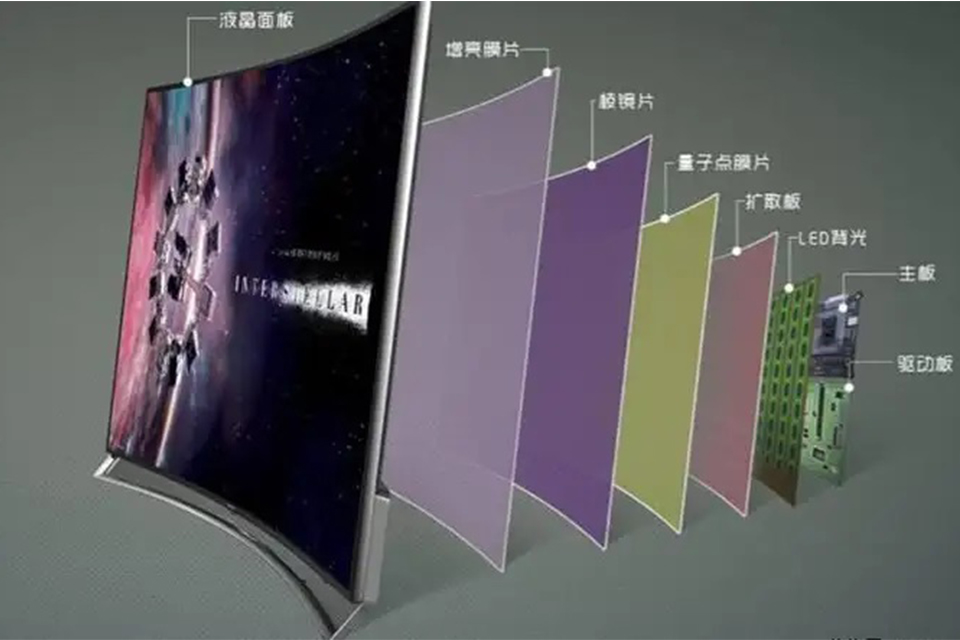
This technology is a new LCD display technology heavily promoted by Samsung, and it also falls under the category of LCD technology. QLED stands for Quantum Dot Light-Emitting Diode, also known as quantum dot display technology. It's a new technology positioned between LCD and OLED, working by using a blue LED light source to illuminate quantum dots, exciting them to emit red and green light. The core technology of QLED is "Quantum Dot," which is composed of zinc, cadmium, selenium, and sulfur atoms. QLED display technology places the quantum dot optical material between the backlight and the liquid crystal panel, allowing the color gamut to reach or exceed that of OLED. It can even eliminate the polarizer on the light source side, effectively reducing the manufacturing cost of LCD products. The unique advantages of quantum dot QLED display technology effectively increase TV brightness by 30-40%, significantly improving the color conversion efficiency of the backlight system, resulting in brighter and more vibrant colors while also being energy-efficient and environmentally friendly. The brightness and color purity of the image are approximately twice that of WLED backlight systems, demonstrating a significant performance improvement. QLED is a revolutionary technology in the field of liquid crystal technology.
Contact: David
Phone: +8618665976986
Tel: +8675521563288
Email: [email protected]
Add: 305 Room A Buiding Huafeng International Robot Industrial Park Xixiang Bao'an
 hicenda
 David Dang